
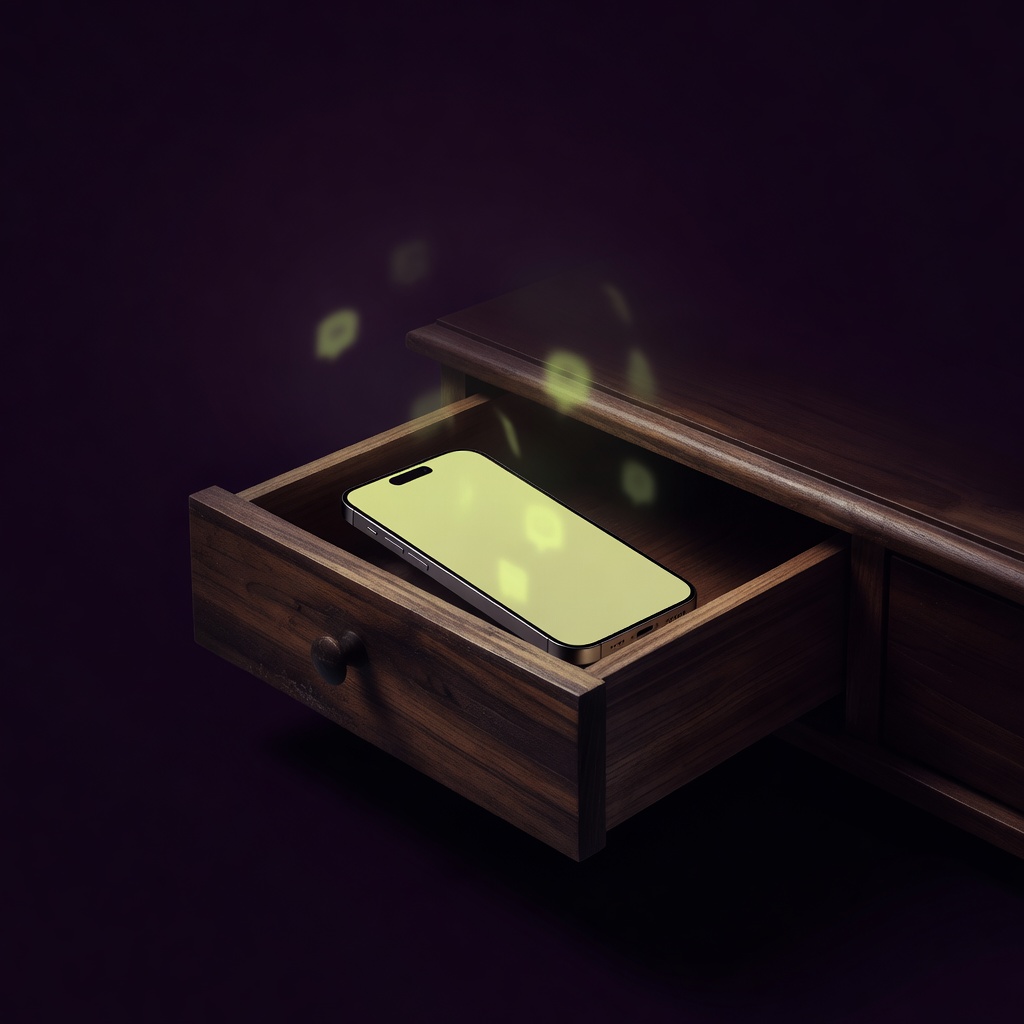
You are allowed to put the phone in a drawer for an hour.
Seriously. You have permission. The business will not collapse. The relationships will not crumble. And you — the person who has been flinching at every buzz since breakfast — might feel noticeably better by the time you pick it back up.
Why Your Body Is Already Paying for This
Our culture has trained us to treat every notification like a potential emergency. Most of them aren't. They're interruptions — and your nervous system can't always tell the difference.
Each ping triggers a small stress response: your heart rate ticks up, your breathing gets shallower, your muscles tighten, and your body releases a little cortisol. Do that fifty times a day, every day, and it accumulates. You end up perpetually braced for something that usually isn't coming.
One focused, phone-free hour won't fix that overnight. But it gives your system a real chance to reset — and you'll often come back clearer, calmer, and more capable of handling what actually matters.
How to Step Away Without the Panic
Prepare (2–5 minutes)
Set a timer on a clock or watch — not your phone. Turn on Do Not Disturb or Focus mode, and if it helps your peace of mind, allow calls through from one or two genuine emergency contacts only.
Then send a quick message to your team: "Stepping away from my phone for the next hour for focused work. If it's urgent, ping [backup person] or flag it as 'urgent' and I'll see it when I'm back."
That's it. You've set expectations. The world knows.
Create coverage (1–3 minutes)
Pick one fallback person — someone who can field a true emergency and knows how to reach you only if something really can't wait. If you work with clients, set a brief autoresponder: "Out of immediate phone reach until [time]. If urgent, please contact [name/number]."
If you manage a team, leave a quick decision rule before you go: "If X comes up, do Y. Otherwise, hold it until I'back." That single sentence prevents most of the "I didn't know what to do" moments.
Make the hour count
Use it for one high-value task — something that requires actual thinking — or use it to rest. A walk, a nap, twenty minutes of genuine quiet. Both are valid.
If anxiety spikes early in the hour, try 4-4-6 breathing: inhale for four counts, hold for four, exhale for six. Two minutes of that will meaningfully lower your stress response.
Re-entry
When the timer goes off, don't scroll everything. Check only what's flagged, what's from clients, or what your backup person left for you. The rest can wait another ten minutes.
Scripts You Can Copy Right Now
To your team via Slack or email:
"I'm unplugging my phone for an hour for focused work. Urgent issues: contact [backup name]. I'll be back at [time]."
Client autoresponder:
"I'm out of immediate phone reach until [time]. For urgent matters, please contact [backup name/phone]. I'll reply as soon as I'm available."
Voicemail:
"I'm temporarily unavailable by phone until [time]. If this is urgent, please text 'URGENT' and someone from my team will respond."
For the Part of Your Brain That's Still Worried
Here's what's actually true: genuine emergencies that require your immediate phone-based decision are rare. They feel common because notifications are constant — but volume isn't the same as urgency.
Teams and clients adapt quickly to clear, consistent boundaries. What they need is to know you're reachable in principle, and to have a fallback point of contact. That's almost always enough.
If an hour still feels like too much, start with fifteen minutes. Then thirty. Build up to sixty over a few days. And before you put the phone away each time, try this grounding habit: feet flat on the floor, three slow breaths, one quiet statement — "I'll be back at 3:05." It sounds simple because it is, and it works.
The One-Hour Challenge
Try it today. Tell your team you'll be unreachable from X to X+1. Put the phone in a drawer, start your timer, and do one focused thing — or rest, if that's what you actually need.
When the hour's up, notice what happened. Probably: nothing catastrophic. Possibly: you got something real done, or you feel less wrung out than usual.
Your nervous system isn't broken. It's just been running on high alert for a long time. One hour off isn't a risk. It's a reset.
And you've earned it.